Finding arch support inserts for ballet flats is mostly a fit problem. Many inserts add support, but far fewer fit inside a flat without making the heel slip or the toe box feel tight. In most cases, the best choice is not the softest or most padded one. It is the insert that gives your arch enough support while taking up as little space as possible.
A good insert can make ballet flats feel more stable and comfortable for longer wear. A bad one can make the shoe feel smaller within minutes. To narrow the options quickly, focus on three things first: your arch type, the shoe's internal volume, and whether the insert is slim enough to fit comfortably.
Quick Buyer's Guide for Ballet Flats
If you want the short version first, start with the shoe's volume, then consider your arch type. A very shallow flat needs a different solution from a dress flat with a bit more room, even when the two styles look similar.
| Shopper need | Shoe type | What to look for | Insole Options |
|---|---|---|---|
| Very shallow flat | Sleek ballet flat | Ultra-thin 3/4-length support | Pedag 3/4 Insoles |
| Dress flat with a little more room | Office or evening flat | Slim 3/4 insert with a lower profile design | Powerstep Pinnacle 3/4 |
| More control under the heel | Structured flat | Firmer 3/4 shell with low-profile heel support | Superfeet Easyfit 3/4 |
| Flat with removable liner | Dress shoe style flat | Low-profile full-length insole | Form Ultra-Thin |
A slim 3/4 option like the Pedag Holiday 3/4 can work well in many shallow flats because its thin, 3/4-length design leaves the toe area free while adding structured support. A firmer 3/4 insert with low-profile heel support can make sense if you need more control and the shoe still has some room. A low-profile full-length insert is more suitable when the flat has a removable liner and enough depth to accept it without crowding the toes.
If you are comparing options by shoe depth, the insoles for flats collection is the most direct place to start, since it focuses on slim formats made for dress shoes and flats.
Why Ballet Flats Are Hard on the Arch
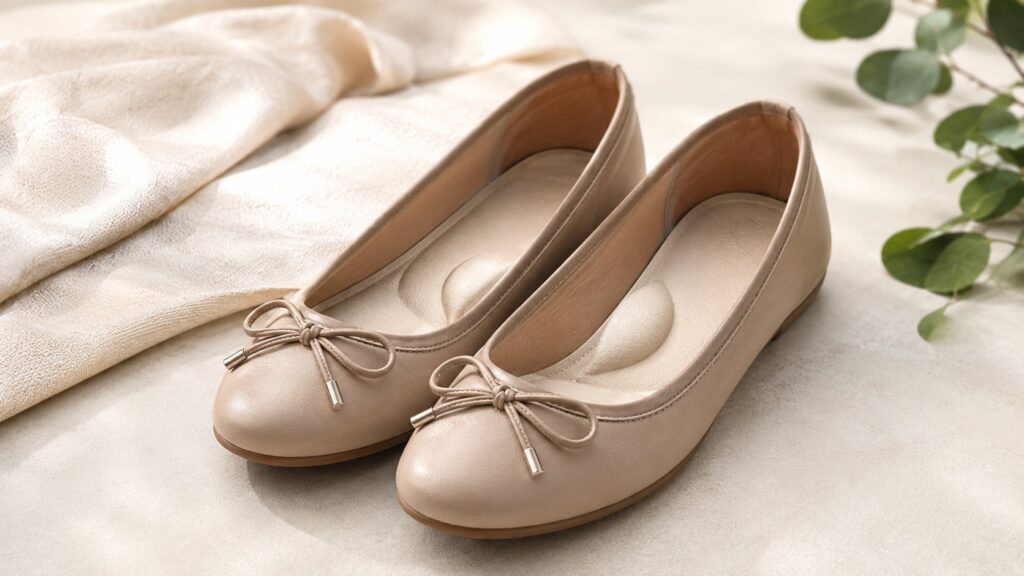
Ballet flats can be challenging when you need more support because they usually offer very little built-in structure. Most pairs have thin soles, minimal heel support, and almost no midfoot reinforcement. That leaves your arch, heel, and forefoot doing more of the stabilizing on their own during everyday walking and standing.
That is also why inserts can be tricky in flats. In most cases, the problem is not just support. It is space. Ballet flats tend to have very low internal volume, so the insert and your foot are competing for the same limited room. Adding arch support can make that tradeoff more obvious. A fit-first approach means starting with whether the insert can physically fit inside the shoe without causing heel slip, toe crowding, or pressure points, then choosing the most supportive option that still preserves that fit. This lines up with the American Podiatric Medical Association’s guidance on foot health and shoe fit, which emphasizes that fit and support need to work together.
When an insert is too thick, it changes how your foot sits inside the shoe. The heel may lift, the toe box may feel tighter, and the arch support may hit in the wrong spot because your foot is no longer seated naturally in the flat.In practice, the issue usually shows up in three ways. The arch still feels unsupported, the heel begins to slip, or the toes start to feel crowded. That is why the softest insert is not always the best choice in a low-volume shoe. In ballet flats, a thinner and more structured insert often works better than a thicker one that simply adds padding.
Matching the Insert to Your Arch Type
A good starting point is your arch shape. From there, narrow the options based on the shoe. An insert that feels comfortable for one foot type can feel intrusive for another, especially in a ballet flat where small shape changes are noticeable.
Low, medium, and high arches in plain English
A low arch or flat foot puts more of the sole near the ground. People with this foot type often notice arch fatigue, tired feet, or pressure near the heel and ball of the foot. A low arch usually feels best when the support makes broad, comfortable contact with the foot rather than pressing up into the arch.
A medium arch tends to do best with balanced support. The insert should cup the heel and meet the arch without pressing too hard. If the arch support is too low, the foot may still feel unsupported. If it is too high, the arch may feel like there is a rock beneath it.
A high arch leaves more space under the midfoot, so these feet often prefer a more defined support shape. But in a ballet flat, shape alone is not enough. The insert also has to fit the shoe without crowding the forefoot.
A simple rule works well here: match the insert to the foot, then make sure it still matches the shoe. If you are sorting through options, the guide on how to choose the right insole can help narrow choices by arch type, use case, and shoe space.
Fit cue: if the insert feels noticeable when you stand up, but does not dig in, you are probably close to the right arch height.
3/4 vs Full-Length and Thin vs Firm
For ballet flats, shape matters just as much as support. An insert can be well made and still be wrong for the shoe if it takes up too much room in the front or lifts the foot too much in the heel. The two most important choices are length and structure.
Why 3/4 length usually works best in flats
A 3/4-length insert stops before the toe box, which helps preserve room in the front of the shoe. That matters because toe crowding is one of the fastest ways to ruin the fit of a ballet flat.
A full-length insert can spread pressure more evenly across the whole footbed. That can help in flats with enough depth, especially if the liner is removable. But in shallow shoes, full-length designs are more likely to crowd the forefoot and lift the heel enough to cause rubbing.
Why firm support often works better than soft foam
Soft foam can feel comfortable at first, but in a low-profile flat it may not hold its shape well enough to support the foot. In many ballet flats, firm arch support with low-profile heel stabilization works better than cushion alone. The goal is to help keep the heel seated without adding more bulk than the shoe can handle, and a firmer shell can better support the arch.
A thin insert that supports the heel and arch often works better than a thick pad that only feels soft at first.
A thin, firm shell can support the foot without changing the fit much. A thicker cushioned insert may feel nice in your hand, but inside the shoe it can raise the foot, crowd the toes, or make the heel slip out.
A good fit starts before you leave the house. First, stand in the shoe for a minute. Then take a few steps. Make sure the heel stays in place, the toes still have room, and the arch feels supported rather than poked.
In slip-on flats, a properly fitted insert will often stay in place once your foot is on top of it. If it slides while you are putting the shoe on, a small piece of adhesive or double-sided tape on the underside can help.
Testing Comfort and Stability Over the First Day
The first wear tells you a lot, but only if you test the insert carefully. A flat that feels fine for a few seconds can still become a problem after an hour, so it helps to check comfort in stages.
The first minute, first hour, and first day
In the first minute, the heel should stay seated and the back of the shoe should not rub. If the heel bounces or the insert shifts, the fit is already off. A good insert should feel noticeable, but it should not feel like a hard lump.
In the first hour, pay attention to the ball of the foot and the toes. Arch support changes how pressure is distributed, but it should not create a new hot spot or make your toes feel numb. If the shoe starts pressing in a new place, the insert shape is probably wrong for that flat.
By the first full day, notice whether the insert improves stability or creates a chain reaction elsewhere. New knee, hip, or lower back strain can be a sign that the shoe and insert are changing your gait in a way that does not suit you.
Research suggests arch support can do more than add cushion. A 2020 study of people with flatfoot found that arch-support insoles changed plantar pressure, foot contact area, stance time, and cadence during level, uphill, and downhill walking. A small 2025 study of women with flatfoot also found lower fatigue-related muscle activity in certain lower-extremity muscles during inclined walking when arch-support insoles were used.
Good match signs: heel stays seated, arch feels supported, toes still have room, and the shoe feels more stable.
Red flags: toe numbness, heel lift, new rubbing, or a hot spot that appears quickly and does not go away.
Choosing the Right Insert and Next Steps
By this point, the buyer’s guide should make more sense. Once you know whether your flat is very shallow, slightly roomier, or able to take a full-length insert, it gets much easier to rule out the wrong models fast. The best result usually comes from balancing three things: arch shape, insert thickness, and how securely the shoe still stays on your foot.
If you are still narrowing it down, start with the least bulky option that matches your arch. For many ballet flats, that means a slim 3/4 insert first. It keeps more room in the toe box and is less likely to change the way the shoe stays on your foot. If your flats have a removable liner or noticeably more depth, then a low-profile full-length insert can make sense.
It also helps to match the insert to how you actually use the shoes. A flat you wear for commuting, office days, or long stretches of standing may benefit from a firmer, more structured insert. A flat you mainly wear for shorter outings may do better with a very slim support option that preserves the original fit.
A final fit check is simple. Your heel should stay seated, your toes should not feel cramped, and the arch support should feel present without becoming distracting. When those three things line up, you are usually close to the right choice.
If you are ready to compare low-profile support by shoe depth and arch shape, visit Insoles.com and browse the slim dress-shoe and flats collections for 3/4-length and low-volume inserts that are easier to fit inside ballet flats.