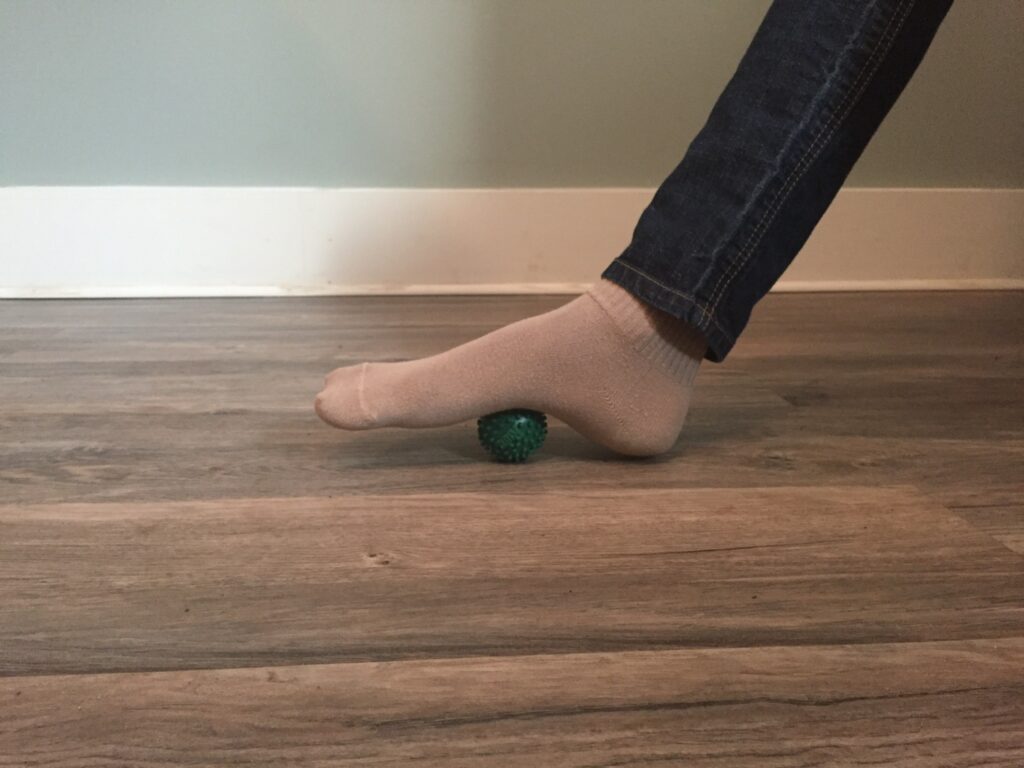

When you're dealing with foot pain, the best approach is usually twofold: first, calm things down, then figure out what's actually causing the problem. Quick fixes like rest and ice can give you immediate relief from irritated tissues, but lasting comfort comes from addressing the root cause with things like supportive footwear and the right insoles.
Getting to the Bottom of Your Foot Pain
Foot pain isn't just a minor inconvenience—it's your body's way of telling you something is wrong.
Maybe it's that sharp, stabbing feeling in your heel first thing in the morning. Or perhaps it's a dull ache in your arch that creeps in after a long day on your feet. Whatever it feels like, ignoring it is a recipe for trouble. You can end up in a cycle of chronic pain and even develop new issues in your knees, hips, and back as your body tries to compensate for the original problem.
Common Culprits Behind Your Aching Feet
What causes your fee to ache so much? The cause is often a mix of lifestyle factors, your unique anatomy, and even your daily habits. Pinpointing the source is the first real step toward finding relief that actually lasts.
Here are a few of the usual suspects I see all the time:
Activity Level: Too much high-impact activity, like running, can seriously strain your plantar fascia. On the flip side, being too sedentary can lead to stiff, weakened muscles that aren't prepared to support you properly.
Improper Footwear: This is a big one. Shoes that offer zero support, cram your toes into a narrow space, or are just plain worn out are a primary driver of conditions like plantar fasciitis and heel spurs.
Foot Structure: The way you're built matters. Your natural arch type—whether you have flat feet or high arches—plays a huge role in how your body absorbs shock and distributes your weight with every single step.
Your First Line of Defense
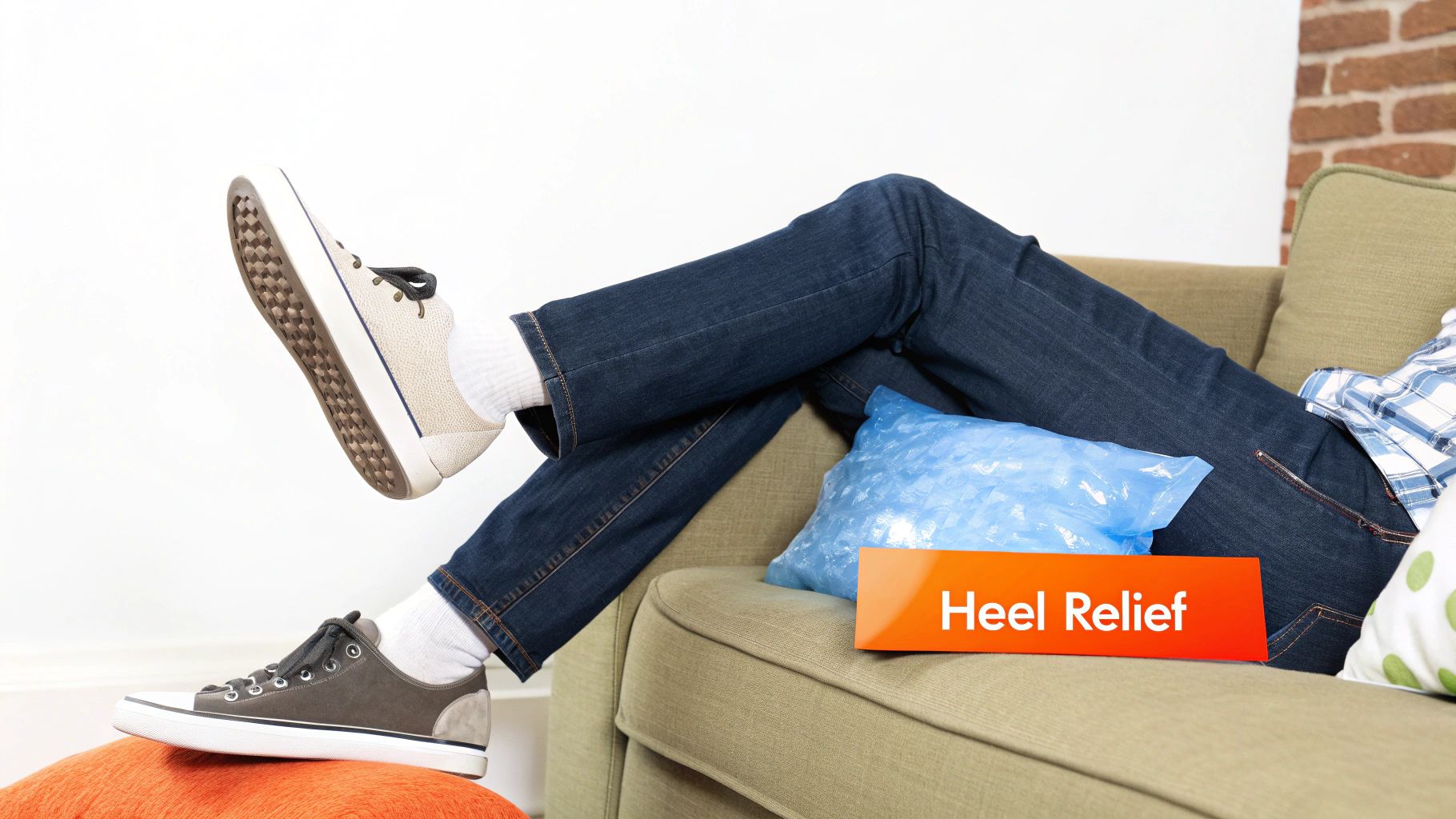
When foot pain flares up, the immediate goal is to reduce that inflammation. Ever heard of the RICE method? It's a great place to start. This isn't the long-term fix, but it's a critical first step to reduce swelling and pain, which sets the stage for real healing.
For a quick reference, here are the immediate actions you should take.
Immediate Foot Pain Relief At a Glance
| Action | Primary Benefit | Pro Tip |
|---|---|---|
| Rest | Prevents further strain on inflamed tissue. | Try to stay off your feet as much as possible for the first 24-48 hours. |
| Ice | Reduces swelling and numbs the painful area. | Apply for 15-20 minutes at a time, several times a day. Never apply ice directly to skin. |
| Compression | Helps minimize swelling. | Use an elastic bandage, but don't wrap it so tightly that it cuts off circulation. |
| Elevation | Uses gravity to drain excess fluid and reduce swelling. | Prop your foot up above heart level while resting. |
These steps are your go-to for immediate triage when pain strikes.
Now, while you're getting the initial flare-up under control, it’s worth thinking about the underlying mechanics. To really figure out what’s going on, a professional musculoskeletal assessment can be incredibly insightful, revealing the true source of pain or weakness.
In the meantime, getting proper support is non-negotiable. Look for shoes with solid structure and good support. Adding high-quality insole can provide the structural alignment your feet desperately need. This combination helps with correcting imbalances and absorbing the kind of impact that just makes the pain worse. Start your journey to relief and Purchase your expertly-selected insoles for pain relief today.
Effective Stretches and Exercises for Foot Resilience
While quick fixes like icing can certainly calm down a flare-up, they don't solve the real problem. Most chronic foot pain stems from underlying weakness or tightness. To get lasting relief, you need to build resilience through targeted stretches and exercises. It’s a shift in mindset—from just managing pain to creating strong, flexible feet that can handle whatever your day throws at them.
Think of all the tiny muscles and ligaments in your feet as a dedicated support crew. When that crew is weak, bigger players like the plantar fascia are forced to pick up the slack, leading to strain and injury. A consistent strengthening routine is how you whip that support system into shape for genuine, long-term relief.
Foundational Movements for Daily Foot Health
You don't need a complicated gym routine to start feeling a difference. Some of the best exercises are surprisingly simple and can be done in just a few minutes while you're sitting at your desk or watching TV. The real secret is making it a habit.
A great place to start is the classic towel curl. Just sit in a chair, place a small towel on the floor in front of you, and use only your toes to scrunch it toward you. It’s a simple move, but it’s incredibly effective for strengthening the intrinsic muscles that support your arch.
Another non-negotiable is the calf stretch. So many people don't realize that tight calves pull on the heel bone, creating massive tension in the plantar fascia. To get a good stretch, stand facing a wall and place your hands on it for balance. Step one foot back, keeping that leg straight and your heel planted firmly on the floor. Lean forward until you feel the stretch in your calf and hold it for 20-30 seconds on each side.
A simple 5-minute routine each morning can be a total game-changer. Before you even get out of bed, gently point and flex your toes and make circles with your ankles. This wakes up the muscles and gets blood flowing right where you need it.
A Targeted Routine for Plantar Fasciitis
If you’re all too familiar with that sharp, stabbing heel pain from plantar fasciitis, a more specific routine can help target the issue directly. The goal is to both stretch the tight fascia and strengthen the muscles that are supposed to be supporting it.
Here’s a practical sequence that works:
Plantar Fascia Stretch: Sit down and cross one leg over the opposite knee. Gently pull your toes back toward your shin until you feel a good stretch along the bottom of your foot. Hold for 15 seconds and do it three times on each foot.
Towel Curls: Do 10-15 reps to activate those crucial arch-supporting muscles.
Marble Pickups: This one almost feels like a game. Put 10-15 marbles and a cup on the floor. Use your toes to pick them up one by one and drop them in the cup. It’s fantastic for improving dexterity.
Wall Calf Stretches: Perform the stretch described above, but hold it for a full 30 seconds on each leg. Do two sets for a deeper release.
Incorporating more dynamic movements like learning to Master The Foot Twist can also be a huge help, engaging your foot muscles in new ways to build comprehensive strength.
Building Strength Beyond the Basics
Once you've got the foundational moves down, you can start adding exercises that build greater stability and shock absorption. The stronger your feet are, the better they can prevent future problems.
Single-leg balancing is an excellent way to improve proprioception—your body's awareness of where it is in space. Start by standing on one foot for 30 seconds. Concentrate on keeping your ankle steady and your arch lifted. Once that feels easy, try it with your eyes closed to really challenge your stability.
These exercises are your toolkit for building a durable foundation from the inside out. But even the strongest feet can benefit from the right external support. Pairing your strengthening routine with the right insoles ensures your feet are protected, aligned, and supported with every single step.
How Your Shoes and Gait Affect Foot Health
While the right stretches can work wonders from the inside out, what you put on your feet every single day is your first line of defense against pain. The link between your footwear, your personal walking style (gait), and nagging foot pain is incredibly strong.
It’s easy to think of shoes as just a fashion choice, but they're a critical piece of equipment for your body. They control how your feet strike the ground, sending forces all the way up through your ankles, knees, and even your lower back. When your shoes and gait are out of sync, it can create a cycle of chronic discomfort with every step you take.
Understanding Your Unique Gait
Your gait is your personal pattern of walking—it's as unique as a fingerprint. It also plays a massive role in your foot health. The two most common mechanical patterns that set the stage for pain are overpronation and supination.
Overpronation is when your ankle rolls too far downward and inward as you step. This flattens and stretches the arch, putting a major strain on the plantar fascia. It’s a common culprit behind heel pain, arch pain, and even shin splints.
Supination (also called underpronation) is the exact opposite. Your foot rolls outward, which concentrates pressure on the outer edge of your foot and smaller toes. While less common, this pattern can lead to problems like stress fractures and an unstable ankle.
How to Check Your Gait at Home
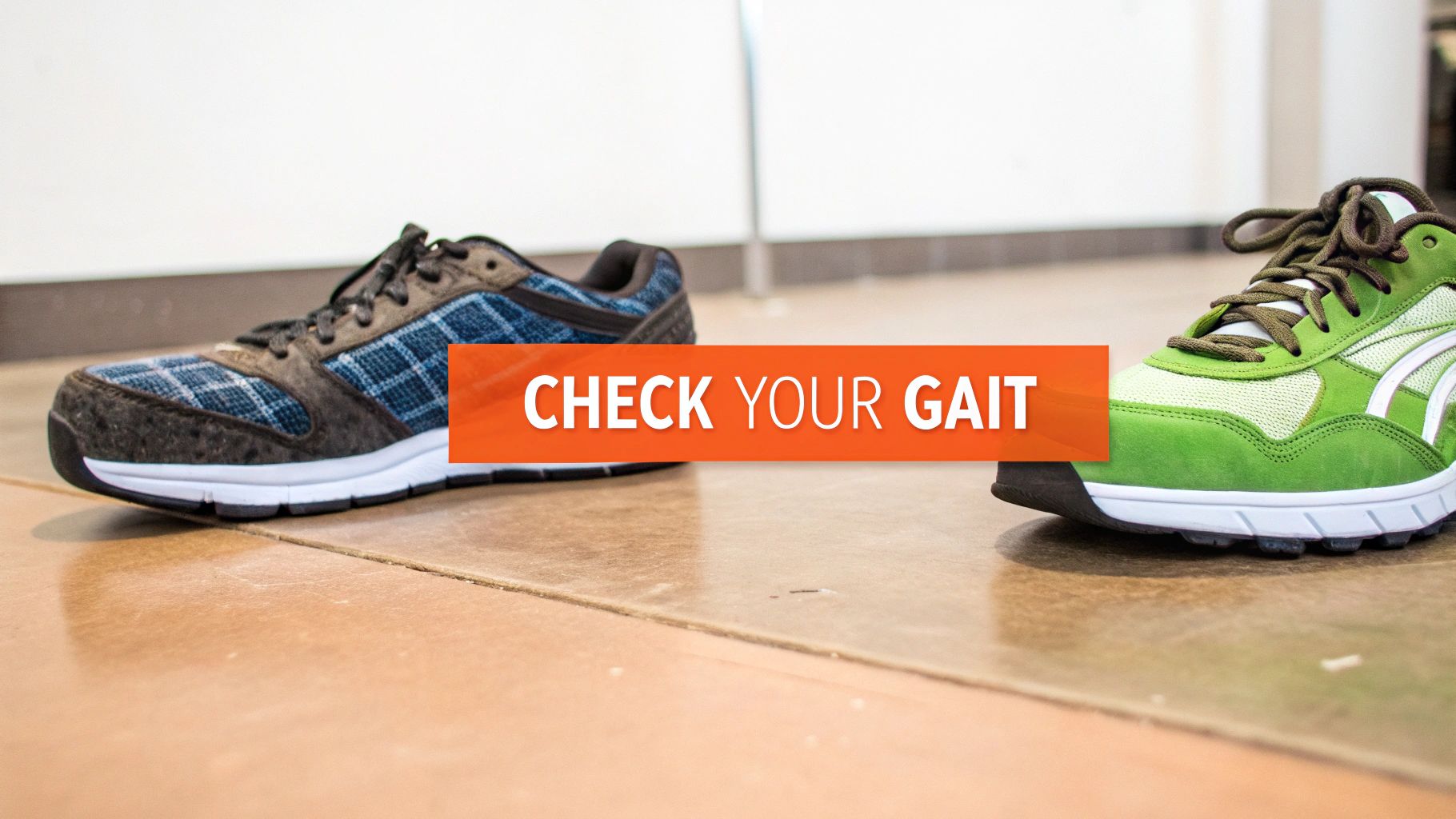
You don't need a high-tech lab to get a good idea of what your feet are doing. The wear pattern on an old, well-loved pair of shoes tells a pretty clear story.
Pull out a pair of your go-to sneakers and flip them over:
Even Wear: If the wear is mostly down the center, from the ball of the foot to a small part of the heel, you likely have a neutral gait.
Excessive Inner Wear: See significant wear along the inside edge of the sole, especially near the big toe? That's a classic sign of overpronation.
Excessive Outer Wear: If the outside edge of your shoe is worn down way more than the rest, you probably supinate.
This simple check gives you a ton of insight into what your feet deal with all day long. To get a deeper understanding of how this can lead to pain, you can read more about overpronation and its effects.
Your gait isn't just about your feet. When your foot alignment is off due to overpronation or supination, it creates a chain reaction that can misalign your entire body, contributing to knee, hip, and back pain.
Choosing Footwear That Actually Supports You
Once you know a little more about your gait, you can shop for shoes much more intelligently. The goal is to find footwear that works with your natural mechanics, not against them.
First, look for a firm heel counter—that's the part that cups your heel. Give it a squeeze. If it collapses easily, it’s not going to provide the stability you need to control motion.
Next, make sure there's enough room in the toe box. You should have about a half-inch of space between your longest toe and the end of the shoe. A cramped toe box is a fast track to bunions, hammertoes, and nerve pain.
Finally, a good shoe should have some torsional stability. If you try to twist it like a wet noodle and it folds right up, it's not supportive enough. You want some resistance, which helps guide your foot through a proper stride.
But here's the thing: even the best shoe has its limits. The factory liner that comes inside is usually just a thin piece of foam. This is where the right insole becomes an absolute game-changer.
Pairing a supportive shoe with an insole designed for your gait pattern is how you turn a good shoe into a great one. An insole provides the specific arch support and heel stabilization that generic shoes can't, helping to correct your alignment and deliver true foot pain relief. This one-two punch is the ultimate strategy for turning every step into a comfortable, pain-free one.
Once you've got your footwear dialed in and you understand your gait, the next step is adding a layer of truly personalized support. This is where a good pair of insoles can transform a decent shoe into an incredible tool for pain relief. They provide targeted support that the flimsy factory liners just can't offer.
Shopping for insoles can feel like a maze of options, but it's actually pretty simple when you know what to look for. The trick is to match the insole's design to your specific needs—your pain points, your foot's unique shape, and what you do all day. Try out the insole advisor for recommnedations for your specific arch and shoe type.
Cushioned Comfort vs. Structural Support
First things first, let's clear up the biggest point of confusion: the difference between soft, cushy insoles and firm, supportive orthotics. They do very different jobs, and picking the right one is essential for actually feeling better.
Soft, Cushioned Insoles: Think gel or memory foam. Their main purpose is shock absorption and easing pressure. These are great if you're dealing with general foot fatigue from standing on concrete all day or if you've lost some of that natural padding on the bottom of your feet.
Firm, Functional Orthotics: These are built from tougher stuff like high-density foam or composites. Their goal is to provide real structure, control motion (like overpronation), and get your foot back into proper alignment. This is what you need for conditions like plantar fasciitis, nagging arch pain, and heel spurs where the root cause is a biomechanical issue.
A simple way to think about it is that cushioned insoles are like pillows for your feet, while functional orthotics are the foundation for your house. One offers softness, the other provides stability.
Choosing the right insole isn't about finding the softest, squishiest option. Lasting relief often comes from firm, structured support that corrects alignment issues, rather than just masking the symptoms with temporary cushioning.
Aligning Insoles with Your Arch Type
Your arch type—whether it's flat, neutral, or high—is a huge piece of the puzzle. An insole that's wrong for your arch can create new problems and even make your pain worse.
You can get a pretty good idea of your arch profile with the simple "wet test." Just get the bottom of your foot wet and step onto a piece of cardboard or dark paper.
Flat Arch: If your footprint looks like the whole bottom of your foot, you probably have flat feet. You'll need an insole with firm arch support to keep your foot from rolling inward (overpronation).
High Arch: See just your heel, the ball of your foot, and maybe a thin line on the outside? You've got high arches. You'll want an insole with cushioned, flexible arch support to help absorb shock, since your arch isn't doing it naturally.
Neutral Arch: If your footprint has a nice, distinct curve along the inside, you have a neutral arch. A moderate level of support is perfect for keeping everything in proper alignment.
Matching the insole to your arch is a non-negotiable step toward balanced, pain-free movement. For a more detailed walkthrough, check out our guide on how to choose the right insole for your foot type.
Matching Your Insole to Your Pain and Lifestyle
Now that you know your arch type, the last step is to connect the dots between the insole's features, your specific pain, and your daily life. A marathon runner with plantar fasciitis needs something completely different from a retail worker who just wants to get through a long shift without aching feet.
This is where you'll see different brands really shine. Names like Superfeet, PowerStep, and Currex have built their reputations by engineering insoles for specific problems and activities. For instance, Superfeet is famous for its deep, structured heel cup that offers amazing stability, making it a go-to for hikers and anyone battling overpronation. PowerStep is often recommended by podiatrists for heel pain, thanks to their wide range of clinically proven designs. And Currex focuses on dynamic, flexible insoles made for specific sports like running, cycling, or soccer.
Choosing the right insole can be a game-changer, especially since so many people are trying to solve foot pain on their own. A KURU Footwear survey found that a whopping 81% of Americans have had foot pain, but only 32% ever get a formal diagnosis. That leaves millions searching for answers. With issues like arch pain (39%) and heel discomfort (35%) being so common, a targeted insole is one of the most effective solutions out there. You can discover more insights about these foot pain statistics and see just how widespread these problems are.
To make this even easier, we've put together a quick guide to help you find the right type of insole based on what's hurting and what you're doing.
Insole Selection Guide by Symptom and Activity
| Symptom / Condition | Recommended Insole Type | Best For Activities | Example Brands |
|---|---|---|---|
| Plantar Fasciitis | Firm arch support with a deep heel cup | Walking, running, standing for long periods | PowerStep, Superfeet, Cadence, Form |
| Flat Feet / Overpronation | Rigid or semi-rigid orthotic with posting | Everyday wear, hiking, court sports | 10 Seconds, Powerstep |
| High Arches | Cushioned insole with flexible arch support | High-impact activities like running and basketball | Currex, 10 Seconds, Form |
| Heel Spurs / Heel Pain | Cushioned heel cup or gel padding | Standing, walking, casual wear | 10 Seconds, Cadence, Powerstep, Birkenstock |
| General Foot Fatigue | Memory foam or full-length cushioned insole | Service industry, retail, healthcare | Cadence, Powerstep, Form |
| Ball of Foot Pain (Metatarsalgia) | Insole with a metatarsal pad | All activities, especially in dress shoes or heels | Pedag, Birkenstock, 10 Seconds |
This table should give you a solid starting point for finding relief. By thinking through cushion versus support, your arch type, and your lifestyle, you're ready to pick the perfect pair. Investing in the right insoles is a direct investment in your comfort and mobility. Find the insoles that are right for you and take the first step toward lasting relief today.
Knowing When to Consult a Professional
While the right stretches, supportive shoes, and quality insoles can work wonders for most common foot issues, some situations really do demand an expert eye. Self-care is a powerful tool, but it's just as important to recognize the red flags that signal a more serious problem.
Ignoring these signs can turn a manageable issue into a chronic condition or a more significant injury down the line.
Think of it this way: if your pain keeps getting worse despite your best efforts at home, that's your body telling you it's time for professional backup. Sharp, shooting pain, visible swelling that won't go down, or being unable to put weight on your foot are all clear signals to get help, and fast.
Red Flags That Warrant a Doctor's Visit
Some symptoms should never be brushed aside. If you experience any of the following, it’s time to make an appointment with a specialist:
Numbness or Tingling: A persistent "pins-and-needles" feeling could point to nerve damage that needs a proper diagnosis.
Pain After an Injury: If your foot hurts after a specific fall, twist, or impact, you might be dealing with a fracture or a significant tear.
Signs of Infection: Be on the lookout for redness, warmth, tenderness, or any discharge from a wound or sore on your foot.
Remember, seeing a professional isn't admitting defeat—it's a smart move on your foot health journey. An expert can give you a definitive diagnosis and create a targeted treatment plan that your insoles and exercises can then support.
Consistency is Important
When dealing with foot pain, it is essential to maintain a regular routine that includes using proper support, such as orthotic insoles, and performing stretching exercises regularly. Ensuring that you consistently wear shoes with sufficient support is vital, as even one day of using footwear without the necessary support can impede progress. Therefore, to achieve results and experience relief, it is important to adhere to these practices diligently.
At Insoles.com, our team of Board-Certified Pedorthists is here to help you find that perfect match. Purchase your expertly-selected insoles today and start your journey toward lasting comfort.