
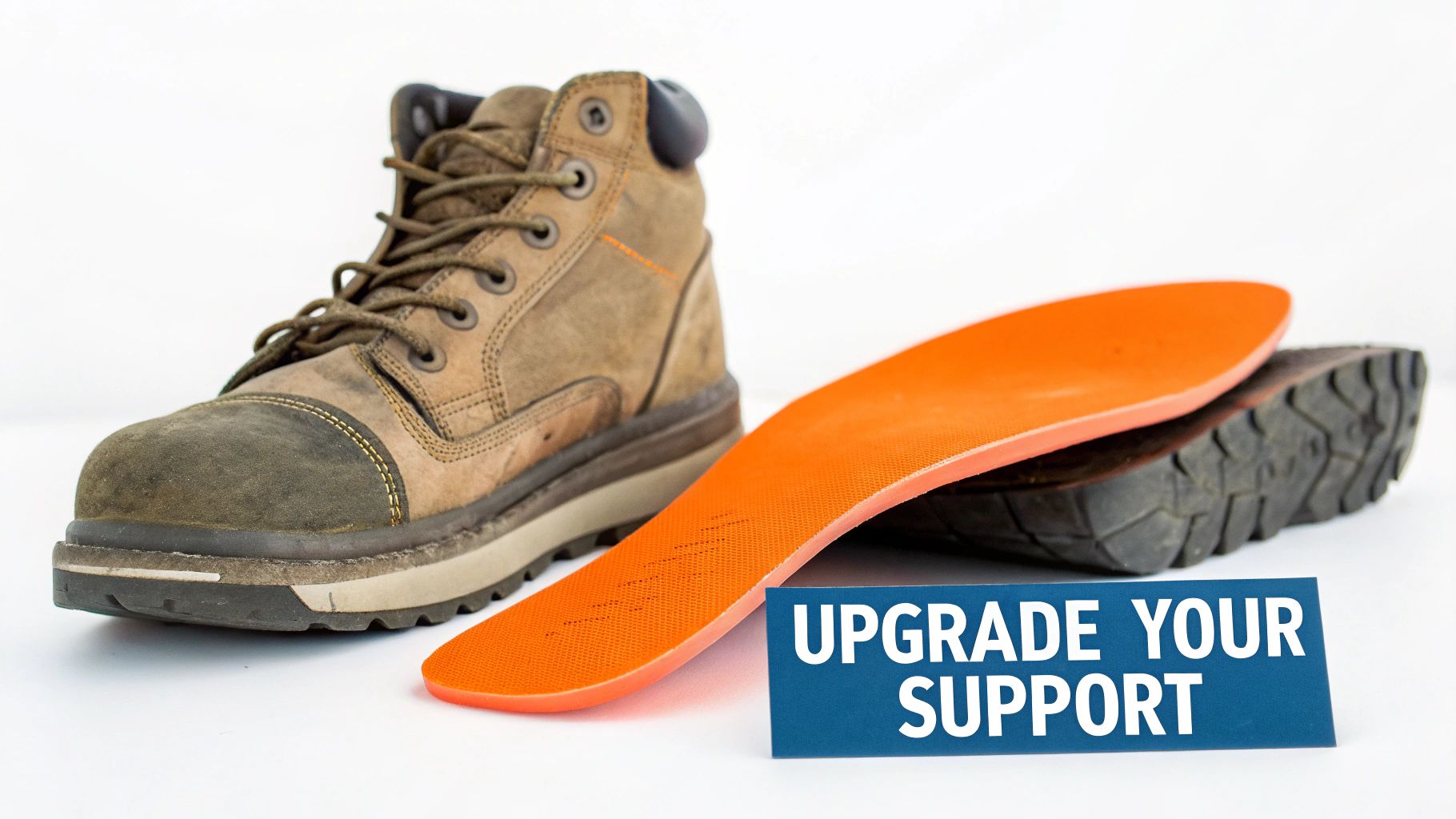
If you’re clocking out of a long shift with tired, aching feet, chances are the flimsy inserts that came with your work boots are to blame. Let's be honest: most factory insoles are just placeholders. They aren't real support systems built for the brutal demands of an 8 to 12-hour workday.
Upgrading to a quality pair of insoles for work boots is the single biggest improvement you can make for daily comfort and preventing long-term foot problems. Ready to find your perfect pair? Shop our collection of work boot insoles today.
Why Stock Shoes Insterts Are Costing You More Than You Think
Picture your work boots as a powerful, heavy-duty truck engine, built for durability and protection. Now, think of the stock insole as cheap, watered-down gas. The engine might be tough, but running it on bad fuel tanks its performance, causing it to sputter and eventually break down.
That’s exactly what's happening inside your boots. Those basic foam cutouts do next to nothing to support your body’s foundation. They simply weren't designed to handle the thousands of steps you take every day on hard surfaces like concrete, steel, or gravel. They lack the structure to properly align your feet, absorb shock, or distribute your weight evenly.
The Hidden Costs of Inadequate Support
The fallout from relying on these flimsy inserts goes way beyond a little foot soreness at the end of the day. Over time, poor support can set off a chain reaction of painful, chronic conditions that travel from your feet all the way up your body.
-
Plantar Fasciitis: This is the #1 cause of heel pain, and it’s often triggered by a lack of solid arch support during long hours on your feet.
-
Knee and Back Pain: When your feet are out of alignment, it creates a domino effect of stress that rattles your knees, hips, and lower back.
-
Reduced Productivity: Let's face it, constant foot pain is a major distraction. It drains your energy, kills your focus, and directly hurts your performance on the job.
Proper insoles are a vital piece of your gear. You need head-to-toe safety, and quality insoles are a non-negotiable part of that system. They aren't a luxury—they are essential.
A smart investment in the right insoles for your work boots is an investment in your long-term health, your daily comfort, and your ability to get the job done right. It turns your boots from a basic necessity into a high-performance tool.
This guide will walk you through finding the perfect support system for your feet and your specific job. Don't let another day end in pain. Ready to feel the difference? Explore our expertly curated collection of work boot insoles today and find the perfect match to transform your comfort on the job site.
Decoding Your Footprint to Find the Right Support
Before you can pick out the right insoles for work boots, you have to know what you’re working with. Think of your feet as the foundation of a building—they need the right kind of support for the ground they're on. The single most important factor here is your arch type.
Your arches are the body's built-in suspension system. They're designed to flex and absorb the shock of every step you take on hard concrete floors or uneven job sites. But not all arches are the same, and that’s where a lot of common foot pain starts.
The Three Primary Arch Types
There are three main arch types, and each one handles your body weight and daily impact very differently. Figuring out which one you have is the first real step toward getting the relief you need.
-
Neutral Arches: This is what you might call the "biomechanically ideal" foot. A neutral arch gives you a great balance of flexibility and stability, letting your foot work just as it's supposed to.
-
Low Arches (Flat Feet): With a low arch, pretty much the entire sole of your foot hits the ground. This often makes the foot roll too far inward, a movement we call overpronation.
-
High Arches: A high arch is usually more rigid, with less surface area to absorb impact. This can cause the foot to roll outward, which is known as supination or underpronation.
This inward or outward rolling is a huge deal. A little bit of both is needed for normal gait. It is when the rolling becomes excessive that problems arise. Imagine your feet are the tires on your truck. If the alignment is off, the tires wear out unevenly, and that stress travels right up into the truck’s frame. It’s the same with your body—overpronation or supination creates an imbalance that sends shockwaves up through your ankles, knees, hips, and even your lower back.
The Simple Way to Find Your Arch Type at Home
You don't need a fancy lab for this. The "wet test" is a classic for a reason, and you can do it right now with stuff you already have at home.
-
Pour a little water into a shallow pan or baking sheet.
-
Step into the water with one foot, just enough to get the bottom completely wet.
-
Carefully step onto a piece of cardboard or a dark towel that will show your footprint clearly.
-
Step off and take a look at the print you left behind.
A footprint showing about half of your foot means you have a neutral arch. If you can see almost the entire bottom of your foot, you likely have low arches. If you only see your heel and the ball of your foot connected by a thin line, you’ve got high arches.
Knowing your arch type is everything because it tells you exactly what kind of support to look for. A worker with flat feet needs an insole that stops that excessive inward roll. On the other hand, someone with high arches needs cushioning that fills the gap under their arch to distribute pressure correctly. For a deeper look, check out our complete guide on how to choose the right insole.
You can also skip the guesswork and use a tool like our Insole Advisor. It simplifies the whole process. Just answer a few quick questions about your feet, your job, and your boots, and it will match you with the perfect support. In just a few seconds, you get an expert-backed recommendation without any of the hassle.
Now that you've got the foundational knowledge about your own feet, you’re ready to make a choice that actually works. Stop guessing and find the perfect insoles for your arch type now.
Comfort Cushioning vs. Corrective Support
Insoles are built with different levels of firmness for different jobs. You have to understand the difference between a simple cushioned insole and a corrective orthotic insole to find a real solution to your foot pain. It’s like the difference between putting a pillow under your head and wearing a neck brace—both can feel good, but only one is designed to correct an underlying problem.
Your job dictates, foot structure, and medical history can help determine whether you need soft cushioning for general fatigue or a firm, structured insole to correct how your foot functions throughout the day. Getting this choice right is fundamental to achieving lasting relief.
Now, let's look at how the actual structure of an insole provides different levels of control.
-
Cushioned Arch Supports: These are flexible and built for comfort and shock absorption above all else. They are best for people with neutral arches who don't have major alignment issues but get tired, achy feet from long hours of standing or walking.
-
Semi-Rigid Orthotics: These strike a balance between support and flexibility, usually featuring a firm-but-pliable support shell. They are the go-to choice for mild to moderate overpronation (rolling in) or supination (rolling out), giving you the correction you need without feeling like you have a board in your boot.
-
Rigid Orthotics: These provide maximum support and are designed to control your foot's motion in a big way. They're typically recommended for significant biomechanical problems, flat feet, or conditions that require your foot to be held in a very specific alignment.
By understanding both the material and the structure of an insole, you can move past the one-size-fits-all approach. You can now confidently pick a pair of insoles for work boots that not only feels great but is truly engineered to handle the unique challenges of your workday. Upgrade your work boots with the right insoles today.
Solving Common Foot Pain on the Job
Let's be honest, you're probably not shopping for insoles for work boots just for fun. More likely, something hurts. That nagging pain is your body's alarm system, screaming that your foundation is under some serious stress. This section is your guide to shutting that alarm off by matching the right insole to the right on-the-job ache.
Think of it like this: you wouldn't use a hammer to drive a screw. In the same way, the features you need to fight heel pain are totally different from what you need to relieve pain in the ball of your foot.
The Right Fix for Plantar Fasciitis
Plantar fasciitis is the number one cause of heel pain, especially for folks who spend all day standing or walking. It's that sharp, stabbing pain right near your heel, usually at its worst with those first few steps in the morning. It happens when the plantar fascia—that thick band of tissue on the bottom of your foot—gets strained and inflamed.
The flimsy factory inserts that came with your boots? They offer zero defense. To really fight back, you need insoles with two critical features:
-
A Deep Heel Cup: This is huge. It cradles your heel's natural fat pad, giving you stability and absorbing the shock that shoots through your heel with every single step. It basically locks your heel in place, preventing the tiny, damaging movements that keep irritating the fascia.
-
Firm Arch Support: This is completely non-negotiable. A supportive, semi-rigid arch lifts the plantar fascia, which takes the strain off and gives it a chance to heal. Soft, squishy insoles just collapse under your weight and won't provide any real therapeutic benefit.
Soothing Metatarsalgia and Ball-of-Foot Pain
Feel a burning or sharp pain in the ball of your foot, right behind your toes? That's a classic sign of metatarsalgia. This happens when the metatarsal bones at the front of your foot get inflamed, usually from constant pressure on hard floors or from footwear that shoves all your weight forward.
For this specific problem, you need an insole that can redistribute pressure away from that sensitive spot.
The secret weapon for metatarsalgia relief is a metatarsal pad. This is a small, dome-shaped pad that sits just behind the ball of your foot. It gently lifts and spreads the metatarsal bones, creating more space and taking the pressure off for almost immediate relief.
This is a perfect example of targeted support. A generic cushioned insole might feel nice for a second, but it does nothing to fix the underlying mechanical issue that's causing the pain in the first place.
Combating Shin Splints and Leg Fatigue
That aching pain that runs up the front of your lower legs—shin splints—is often a direct result of terrible shock absorption and your foot not being properly aligned. Every step you take on a hard surface sends vibrations right up your legs. Without the right support, your muscles and tendons have to work overtime just to keep you stable.
For workers who deal with constant jolts and shakes, the right insoles are a critical way to mitigate whole body vibration risks that can lead to chronic pain and fatigue. The solution is a one-two punch of features:
-
Superior Shock Absorption: Look for materials like gel or high-rebound foam. These act like a suspension system for your feet, damping the impact before it ever gets a chance to travel up your leg.
-
Pronation Control: A lot of shin splint cases are tied to overpronation (when your foot rolls too far inward). An insole with a firm arch and a deep heel cup helps correct this motion, stabilizing your foot and cutting down on the rotational stress that tortures your shins.
Choosing the right support isn't just about comfort; it's a smart move for your health and productivity. Stop letting foot pain run your workday. Once you identify your specific symptoms, you can pick an insole that's engineered to solve your exact problem. Find targeted relief and purchase the right insoles for your pain today.
Special Considerations for Steel-Toe Boots
Fitting insoles into steel-toe or composite-toe boots demands extra attention. That protective cap creates a hard, unforgiving boundary, so every millimeter of space is precious.
When you're trimming insoles for safety-toe boots, precision is everything. An insole that's even slightly too long can bunch up against the toe cap, creating pressure spots that can lead to some nasty blisters. The goal is a seamless fit that supports your foot without cramping your toes.
Once the insole is in, put your boots on and walk around for a bit. How do your toes feel? You should have enough room to wiggle them freely, without them feeling pinched or pressed against that steel cap. For more in-depth sizing advice, check out our comprehensive insole size guide. If you insoles need trimming, our guide for how to trim your insoles will help.
Your Last Step to All-Day Job Site Comfort
If you've made it this far, you know that true, all-day comfort isn't about guesswork. It really boils down to three things: understanding your unique feet, matching your insoles for work boots to what your job throws at you, and zeroing in on your exact pain points. You now have the roadmap to go from just getting through the day to feeling powerful relief.
Think of it this way: investing in a high-quality insole isn't a luxury. It's an essential piece of your personal protective equipment. Just like your hard hat protects your head, the right support under your feet protects you from the daily grind that leads to chronic injury and missed work. It's a fundamental part of staying safe and productive for anyone who earns a living on their feet.
Your Expert-Backed Solution is Waiting
Here at Insoles.com, we don't take this lightly. Our team, led by Board-Certified Pedorthists, has hand-picked a selection of the absolute best insoles built for the punishing environment of a modern job site. We've done the heavy lifting so you can confidently pick a solution that delivers real, noticeable results.
Don't wait for those minor aches to morph into major problems. The only thing standing between another day of pain and a career of comfort is the support you slide into your boots. Taking this final step is a direct investment in your long-term health.
Stop letting foot pain call the shots. Your perfect match is ready and waiting. It’s time to transform your workday, kick discomfort to the curb, and give your feet the support they've more than earned.
Ready to make a change? Take that next step and explore our full collection of insoles for work boots. Find your fit today and feel the difference proper support makes from the moment you clock in.
Frequently Asked Questions About Work Boot Insoles
Even with the best guide, a few questions always pop up. It's totally normal. Here are some of the most common things we hear from folks on the job, along with some straight-to-the-point answers.
How Often Should I Replace My Work Boot Insoles?
Think of your insoles like the tires on a truck—their lifespan really depends on the mileage and the load. For most workers, a new pair every 6-12 months is a good rule of thumb. Some of this depends on amount of use and some of it depends on the durability of the materials they are made from. The real test is how they feel. If you see them cracking, the arch looks flat, or that old nagging foot pain starts to return, it's time for a fresh set.
Will New Insoles Make My Boots Feel Too Tight?
That’s a real concern, especially if you’re in steel-toe or composite-toe boots where every millimeter counts. The secret to getting it right is choosing an insole with the correct volume for your specific boots.
Here's a quick breakdown:
-
High-Volume Insoles: These offer the most cushion but take up the most room inside your boot.
-
Medium-Volume Insoles: They hit that sweet spot, balancing great cushioning and support without adding a ton of bulk.
-
Low-Volume Insoles: Perfect for snug-fitting boots, these deliver essential support in a slim, low-profile package.
And don't forget the most important step: always take out the original factory liner before putting your new insole in. This one simple move frees up the necessary space and allows your new insole to sit properly and do its job.
Don't let another workday end in pain. At Insoles.com, our expert team is ready to help you find the perfect support engineered for your specific job and foot type. Upgrade your comfort and protect your feet for the long haul.