Think of the flimsy inserts that come with most new shoes. They feel nice for a week, but what are they really doing for you? Not much. That’s where orthotic insoles come in. These are carefully designed medical devices built to support your foot’s structure, correct biomechanical problems, and ultimately, prevent or relieve pain.
They’re less like a cushion and more like prescription glasses for your feet, providing targeted support to improve your alignment and function from the ground up. Ready to upgrade your shoes? Find the perfect pair of insoles to start your journey toward pain relief today.
Understanding Orthotic Insoles and Why They Matter
Your feet are the foundation for your entire body. If that foundation is unstable or out of alignment, it creates a chain reaction of problems that can travel up to your ankles, knees, hips, and even your back.
Orthotic insoles are engineered to fix this fundamental issue. They do more than just add a layer of foam; they provide real, structural support right where you need it most.
Every time you take a step, your feet absorb the force of your entire body weight. Orthotics help manage that impact by distributing the pressure more evenly across your foot. It sounds simple, but it can make a massive difference in how you feel.
More Than Just Cushioning
Before we go any further, let’s clear up a common misconception. The thin foam liners that come standard in most shoes are not orthotics. They’re designed for that initial “store try-on” comfort and little else. They compress quickly and offer zero help for underlying foot problems.
An orthotic insole, on the other hand, is a functional tool. To clarify the difference, here’s a quick comparison.
| Feature | Orthotic Insoles | Regular Cushioned Inserts |
|---|---|---|
| Purpose | To provide biomechanical support and correct alignment issues. | To provide basic cushioning and initial comfort. |
| Support | Firm, structured arch support and heel stabilization. | Soft foam that compresses easily; minimal to no support. |
| Durability | Made from durable materials designed to last for months or years. | Wears out quickly with of regular use. |
| Benefits | Addresses root causes of pain like plantar fasciitis, overpronation, and metatarsalgia. | Offers temporary comfort but does not solve underlying problems. |
As you can see, the goals are completely different. Orthotic insoles, sometimes called foot orthotics, are engineered with specific features to solve common problems:
-
Providing Arch Support: Whether you have flat feet or high arches, a proper orthotic helps maintain your foot's natural shape, taking the strain off your muscles and ligaments.
-
Correcting Alignment: They gently guide your foot into a healthier, more neutral position to prevent issues like overpronation (when your feet roll too far inward).
-
Absorbing Shock: High-quality materials cushion the jarring impact from walking on hard surfaces, protecting your joints from repetitive stress.
This targeted approach has been shown to reduce impact forces, which helps improve your gait and prevent that secondary pain you might feel in your knees and back. If you want to dive deeper into how insoles can help with specific conditions, you can read about more detailed symptoms and conditions or shop our insoles for pain relief.
An orthotic insole isn't just a piece of foam; it's a biomechanical tool designed to restore your body's natural alignment from the ground up.
By tackling the root cause of your discomfort, orthotic insoles offer a proactive way to manage pain and improve your overall mobility. They are an investment in your foundational health, helping you stay active, comfortable, and on your feet. When selecting an orthotic insole it is important to keep in mind your foot structure. High-quality over the counter insoles can be very effective in releiving foot pain. Try our insole advisor for personal recomendations for insoles for pain relief or general support.
How Orthotics Realign Your Body to Relieve Pain

To really get how an insole can help your back, you have to picture your body like a building. Your feet are the foundation. If that foundation is even a little bit off—cracked or tilted—the whole structure sitting on top of it gets stressed. That’s your ankles, knees, hips, and yes, your back.
This whole interconnected setup is called the kinetic chain. You might feel pain in your lower back, but the real culprit is often way down at the bottom: your feet.
Orthotic insoles get to work by fixing that foundation. They don't just add a layer of cushion; they actively steer your feet into a more stable, efficient position. That restores balance all the way up your body. This realignment is the secret sauce to lasting pain relief.
The Problem of Poor Alignment
So many of our everyday aches and pains can be traced back to two main alignment issues with our feet: overpronation and supination. These are just fancy words for how your foot rolls when you walk.
-
Overpronation is when your foot and ankle roll too far inward with each step. It makes your arch flatten out, putting a ton of strain on your plantar fascia, your shins, and the inside of your knees.
-
Supination (or underpronation) is the opposite issue. Your foot rolls too far to the outside, concentrating all the impact on the outer edge. This is terrible for shock absorption and can lead to things like ankle sprains and stress fractures.
A quick and dirty way to check for this is to look at the soles of an old pair of shoes. If the inner edge is worn down, you're probably an overpronator. If the outer edge is shot, supination is the likely suspect.
How Orthotics Correct Your Stride
Think of an orthotic insole as a guide rail for your foot. It provides the structure your foot needs to stay on a neutral, healthy track, stopping it from rolling too far one way or the other.
This correction comes from a few key design features:
-
Structured Arch Support: This is the most important part. A firm, supportive arch stops your foot from collapsing inward (overpronation), which takes the pressure right off the posterior tibial tendon and plantar fascia.
-
Deep Heel Cup: This feature literally cradles your heel, locking it into a stable spot. A good heel cup gives you control and stops that side-to-side wobble that makes both overpronation and supination worse.
-
Stabilizing Shape: The entire shape of an orthotic is designed to spread pressure out evenly across your whole foot. This gets rid of those painful "hot spots" under your heel or the ball of your foot and encourages a much more balanced gait.
By fixing these foundational mechanics, orthotics send a ripple effect of positive change right up the kinetic chain.
When your feet are properly aligned, your ankles, knees, and hips can function as they were designed to, reducing joint strain and alleviating the pain that may have plagued you for years.
The Benefits of a Realigned Foundation
Getting your foot alignment right with a quality orthotic insole does more than just stop foot pain. The perks travel all the way up your body, improving your overall stability and posture.
Ultimately, by stabilizing your foundation, you let your entire body move more efficiently. That means less fatigue at the end of a long day, better balance when you're active, and a real drop in pain from your feet all the way up to your lower back. Don't let poor alignment hold you back. Find the right insoles today and start rebuilding your body's foundation from the ground up.
Choosing Between Custom and Prefabricated Insoles
When you first start looking into orthotic insoles, the biggest choice you'll run into is custom vs. prefabricated. It can feel a little overwhelming, but it really just boils down to a trade-off between a truly personalized fit and immediate accessibility. Each type has its place, and figuring out the difference is the first step to getting the right support for your feet.
A good way to think about it is like buying a suit. A prefabricated insole is like a high-quality, off-the-rack suit from a brand you trust—it's designed to fit most people really well and tackle common problems. A custom orthotic, on the other hand, is a bespoke, tailor-made suit, crafted from a precise mold of your body for a perfect, one-of-a-kind fit.
The Power of Prefabricated Insoles
Prefabricated insoles, often called "off-the-shelf," are what you’ll find from proven brands like Form, Superfeet, PowerStep, Cadence, ProThotics and Currex. These aren't just flimsy gel pads from the drugstore; they are seriously engineered based on decades of biomechanical research to help with the most frequent foot issues, like overpronation, arch strain, and general foot fatigue.
High-quality prefabricated orthotics are built with medical-grade materials and structured designs that provide real, functional support right out of the box.
Here’s why they’re so popular:
-
Accessibility: You can get them right away, online or in a store, with no prescription needed.
-
Affordability: They are much less expensive than custom orthotics, which makes them a fantastic starting point for finding relief.
-
Proven Effectiveness: For the vast majority of common foot conditions, a well-chosen prefabricated insole provides all the support needed to ease pain and improve alignment.
For many people struggling with things like plantar fasciitis or mild alignment issues, a top-tier prefabricated insole is the perfect solution.
The World of Custom Orthotics
Custom orthotics are a more personalized foot support. A medical professional, like a podiatrist or pedorthist, creates them from a specific impression of your feet—using a cast, a foam box, or a 3D scan. This process captures every unique curve and bump, allowing for precision in addressing your specific biomechanical needs.
This level of detail is critical in certain situations:
-
Severe Biomechanical Issues: Think significant structural problems, complex gait abnormalities, or conditions like diabetic foot ulcers where offloading pressure precisely is essential.
-
Unique Foot Shapes: If you have exceptionally high arches, severe flat feet, or other foot deformities, a generic shape just might not cut it.
-
Specific Medical Conditions: Athletes with nagging, recurrent injuries or people with diagnosed conditions often need the tailored correction only a custom orthotic can offer.
The main drawbacks? Cost and time. Custom orthotics can run several hundred dollars and often take weeks to be made.
The decision really comes down to how severe your condition is. For most common aches and pains, a high-quality prefabricated insole is an excellent and effective first line of defense. But for complex, specific, or severe problems, a custom orthotic is an indispensable medical tool.
This infographic lays out the key differences between a personalized custom solution and a high-quality prefabricated one.
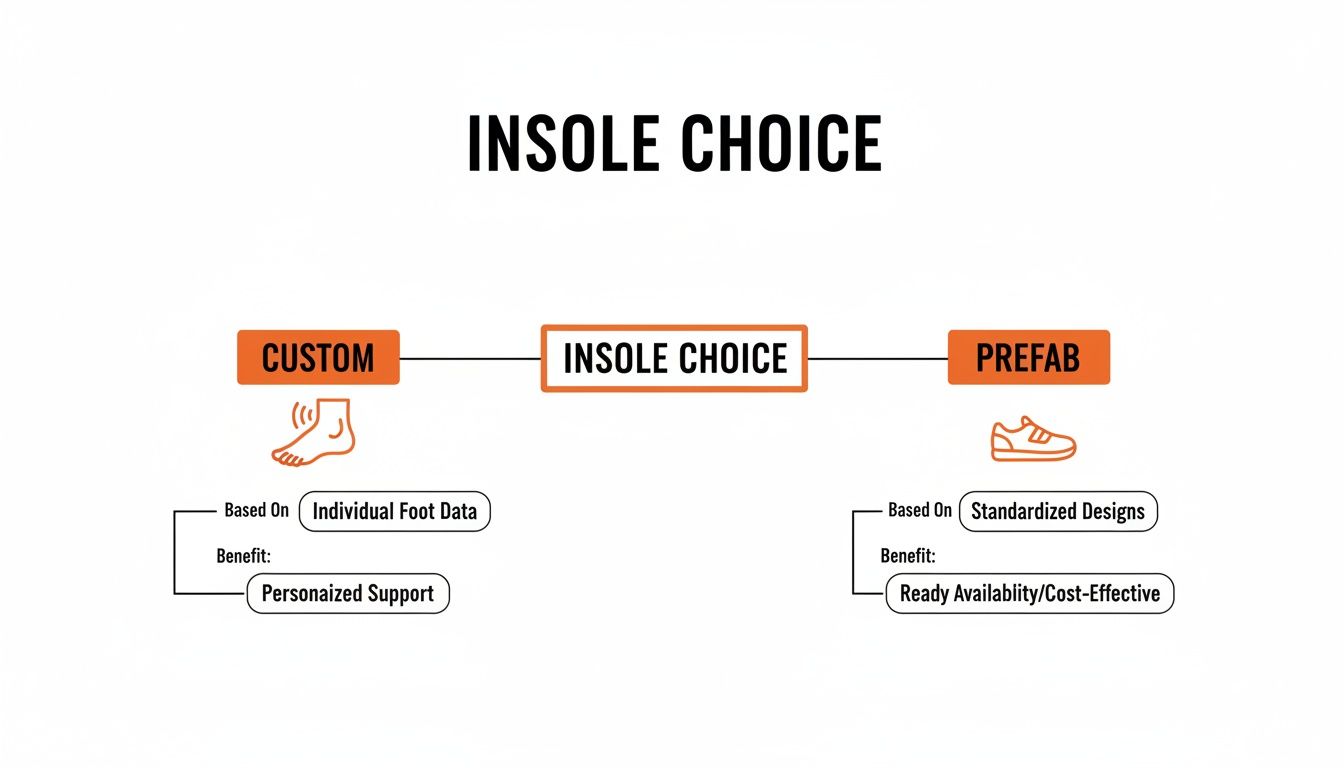
As you can see, while custom insoles are built from precise scans of an individual's foot, prefabricated options are engineered using vast amounts of biomechanical data to solve the most common foot problems with incredible effectiveness.
Understanding Materials and What They Do
The stuff an insole is made of has a huge impact on how it feels and works. Whether you go with custom or prefabricated, the materials dictate the balance between rigid control and soft, flexible cushioning.
-
Rigid (Thermoplastics): These hard plastics offer the most control, making them great for correcting severe overpronation. They are incredibly durable and provide firm, unwavering arch support. This type of insole material is ideal for flat feet and falling arches.
-
Semi-Rigid (Cork, Carbon Fiber, Layered Foams): This is the sweet spot for a lot of people. These materials mix flexibility with solid support, giving you control while still allowing your foot to move naturally. They’re perfect for both everyday wear and athletic activities. These insoles are excellent for both medium and high arches.
-
Soft (Foam, Gel): These are all about maximum cushioning and shock absorption. They’re best for anyone who needs to relieve pressure points, like people with diabetes, arthritis, or fat pad atrophy (when the natural padding on your foot thins out).
Ultimately, picking the right insole is all about matching your unique feet and your specific needs to the right product. If you're ready to find that perfect balance of support and comfort, a great place to start is our guide on how to choose the right insoles.
Matching the Right Insole to Your Foot Pain
Knowing the different types of insoles is a great first step, but the real magic happens when you match the right solution to your specific pain. It’s like using the right tool for the job—you wouldn't bring a hammer to fix a leaky pipe. In the same way, the insole that works wonders for heel pain might do nothing for someone with pain in the ball of their foot.
This is where we connect the dots. By figuring out your specific condition and foot type, you can stop guessing and start making a smart choice that will get you back on your feet without the pain. It all comes down to finding a targeted tool for a targeted problem.
Targeting Plantar Fasciitis
If you've ever felt that sharp, stabbing pain in your heel when you take your first steps in the morning, you're probably all too familiar with plantar fasciitis. This common condition is simply inflammation of the plantar fascia, which is the thick band of tissue running along the bottom of your foot.
To get relief, you have to reduce the strain on this ligament. That means you need an insole with two non-negotiable features:
-
Good Arch Support: This is the big one. A supportive arch keeps your foot from collapsing inward (a motion called overpronation), which is a major cause of strain on the plantar fascia. The support literally lifts the arch, taking tension off that ligament so it can finally start to heal.
-
Deep Heel Cup: A well-structured, deep heel cup is also crucial. It cradles the fatty pad of your heel and provides much-needed stability. This helps absorb shock right where you land and stops the side-to-side wobble that can irritate the inflamed tissue.
A word of caution: for plantar fasciitis, soft and squishy insoles often make things worse. It is usually best to avoid gel and memory foam. They feel nice for a moment, but they don't have the structure needed to control that unhealthy motion.
Explore the most effective insoles for plantar fasciitis to help alleviate discomfort and provide support.
Soothing Metatarsalgia and Ball-of-Foot Pain
Metatarsalgia is the catch-all term for pain in the ball of your foot. It might feel like you're constantly walking on a pebble or have a burning sensation under your toes. This kind of pain is almost always caused by too much pressure on the metatarsal heads (the bones right behind your toes).
The fix is to redistribute that pressure away from the sore spot. The single most effective feature for this is a metatarsal pad—a small, dome-shaped cushion that's built right into the insole.
A metatarsal pad isn't meant to sit directly under the ball of your foot, but just behind it. This position gently lifts and separates the metatarsal bones, which takes the pressure off the nerves and tissues in that area and can provide almost immediate relief.
For people who spend long hours on their feet, especially on hard surfaces, this simple little feature can be a total game-changer. It works by offloading the pressure that's causing the pain in the first place. The best insoles for metatarsalgia will contain a metatarsal pad.
Aligning Your Arch Type with the Right Support
Your arch type—whether it's flat, neutral, or high—is basically the blueprint for the kind of support you need. Using an insole designed for the wrong arch type can be useless at best and downright painful at worst.
-
Flat Feet (Low Arches): People with flat feet often overpronate, meaning their feet roll too far inward as they walk. They need insoles with firm, structured arch support to keep the arch from collapsing and to provide stability. Explore a variety of choices for insoles designed for low arches.
-
Neutral Arches (Medium Arches): If you possess neutral arches, you are considered a "normal" pronator. It is important to maintain proper alignment to ensure comfort and prevent fatigue. To support this, consider using a firm arch support or a semi-rigid insole, both of which should offer moderate arch support combined with cushioning. These features help in providing comfort and reducing the risk of tiredness. There are numerous options available for insoles specifically designed for medium arches, which can be explored further. There are many good options of insoles designed for medium (neutral) arches.
High Arches: High arches are typically more structured and rigid and don't absorb shock very well. This can lead to supination, where the feet roll outward. The best bet here is an insole that offers plenty of cushioning and a flexible arch to help absorb impact and support the entire length of the arch. The cushion should be high quality and durable; anything too squishy will lead to instability. Here is a list of high-quality insoles for high arches.
Not sure what your arch type is? There's an easy way to check. Just wet the bottom of your foot and step onto a piece of cardboard. A full, wide footprint suggests flat feet, a very narrow print means you probably have high arches, and anything in between points to a neutral arch.
Now that you're armed with this knowledge, you can pinpoint exactly what you need. If you'd like a little more guidance, our Insole Advisor can point you to the perfect pair based on your pain, foot type, and daily activities. Don't let the pain get worse—find the insoles built to solve your problem today and take the first step toward lasting comfort.
Finding the Best Insoles for Your Lifestyle
Figuring out what's causing your foot pain is only half the job. The other, equally important half is finding an insole that actually fits your day-to-day life. It makes sense, right? The perfect orthotic for a marathon runner is going to look completely different from one made for a construction worker. Your activities determine the kind of stress your feet are under, and your insoles need to be up for that specific challenge.
It’s a bit like picking out tires for a car. You wouldn't slap racing slicks on an off-road truck and expect good results. In the same way, the intense demands of high-impact sports require features like shock absorption, while spending long hours on your feet calls for serious cushioning and stability.
Insoles for High-Impact Activities and Running
Every time you take a stride while running, your feet slam into the ground with a force equal to several times your body weight. That repetitive, high-impact stress is exactly why runners need insoles that are absolute masters of shock absorption and energy return.
You'll want to look for insoles built with advanced cushioning and a structure that's flexible but still supportive. Brands like Currex are fantastic at this—they design insoles that move naturally with your foot, boosting comfort without adding a ton of bulk or making your shoes feel stiff. The whole point is to cut down on fatigue and help prevent those classic running injuries like shin splints or runner's knee by soaking up the impact.
Support for Long Days on Your Feet
If you spend all day standing or walking on hard floors—think nurses, retail workers, or warehouse employees—your main enemy is fatigue that builds up over time. That constant pressure can leave you with aching arches, stabbing heel pain, and even lower back soreness by the end of a shift.
For this, the ideal insole offers a solid mix of plush cushioning and firm, dependable arch support. You need something that spreads pressure out evenly and keeps your arches from collapsing under the strain of a long day. Look for insoles with a deep heel cup and a structured arch to help you stay properly aligned from morning to night. Cadence Orignial Insoles are an all time favorite for long days on our feet.
An insole for the workplace is more than just a comfort item. Think of it as personal protective equipment for your feet, knees, and back, preventing the slow-burn damage that comes from standing on unforgiving concrete all day.
Stability for the Trail and Outdoor Adventures
Hiking and trail running throw a whole different set of problems at your feet. A trail isn't a smooth, predictable sidewalk; it's covered in rocks, roots, and uneven ground. This means you need an insole that prioritizes rugged stability to keep you from rolling an ankle or getting other injuries.
For your hiking boots, a semi-rigid orthotic insole is usually the way to go. You want firm arch support and a deep, stabilizing heel cup. These features essentially lock your foot into place, giving you the control you need to tackle tricky terrain. The materials also need to be tough enough to handle the outdoors while still providing enough cushion to absorb the impact, especially if you're carrying a heavy pack. FORM Heat-Moldable insoles are a favorite for a customized fit on the trail.
Remember, this is just a starting point. The best insole for you will always be the one that feels most comfortable and supportive for your unique feet and activities.
Ultimately, figuring out what orthotic insoles are is all about connecting the dots between an insole's features and your own lifestyle. Once you consider your daily activities and the shoes you wear most often, you can find a solution that feels like it was made just for you.
Ready to stop guessing and start experiencing real relief? Explore our collections of activity-specific insoles and find the perfect pair to support your lifestyle today.
Breaking in Your New Insoles
You’ve picked out the perfect pair of orthotic insoles. Now what? Getting them fitted and broken in correctly is the last, but most important, step. A proper setup is the only way to make sure your insoles can do their job and give you the support you paid for.
Your body is going to need a little time to get used to the new support and alignment. This is completely normal—think of it as your muscles learning a new, healthier way to stand and walk, right from the ground up.
Don't make the common mistake of wearing your new insoles all day from the get-go. A slow and steady approach is the best way to avoid any initial soreness while your body adjusts.
Start by wearing them for just an hour or two on the first day. Then, you can add about an hour of wear time each day after that. Most people find that after about one to two weeks, they can wear their insoles all day without even thinking about it.
How Long Does It Take to Get Used to Them?
Give yourself a little grace period—usually about one to two weeks. Your feet, ankles, and even your lower back are learning a new, healthier way to align, and that adjustment takes time.
We always suggest easing into it. Wear your new insoles for just 1-2 hours on day one. Then, add an hour each day. It's normal to be "aware" of them at first, but if you feel any sharp pain, take them out and give an expert a call.
Think of it like starting a new workout routine. Your body is adjusting to a better posture, and a slow and steady start prevents soreness while you transition to all-day support.
Care and Replacement
Want to get the most life out of your insoles? Take them out of your shoes every now and then to air out. If they get dirty, just clean them by hand with a bit of mild soap and water. Whatever you do, don't throw them in the washing machine or dryer.
With good care, a quality pair should last you anywhere from six to twelve months, or about 500 miles of use. You'll know it's time for a new pair when you see visible wear and tear, like cracks in the foam or a flattened arch. Another telltale sign? That old foot pain starts creeping back.
Got Questions? We've Got Answers.
Stepping into the world of orthotic insoles can feel a bit overwhelming, but it's really pretty straightforward once you have the basics down. Let's tackle some of the most common questions we hear from customers.
Do I Need to See a Doctor First?
For most people dealing with general foot fatigue or mild overpronation, a quality pair of prefabricated orthotics is an excellent place to start. Brands like PowerStep or Superfeet offer serious support and relief right out of the box, no prescription needed.
However, if your pain is severe and just won't quit, or if you're dealing with a specific medical issue like diabetic neuropathy or a major structural problem with your foot, you should absolutely chat with a podiatrist. They'll be able to tell you if you're a candidate for true prescription custom orthotics.
Can I Move My Insoles From Shoe to Shoe?
Absolutely! That's one of the best things about full-length prefabricated insoles. You can easily swap them between similar types of shoes, like moving them from your running sneakers to your walking shoes.
Just keep in mind that an insole built for a bulky hiking boot isn't going to slide into a slim dress shoe. It's why a lot of our customers end up owning a couple of different pairs—maybe a robust, cushioned model for their athletic shoes and a sleek ¾ length version for work or dress shoes. This way, you're covered with the right support for any occasion.
Here at Insoles.com, our team of experts is always ready to help you find the perfect partner for your feet, your shoes, and your life. Don't let foot pain call the shots another day—explore our collections and take the first step toward real comfort!